
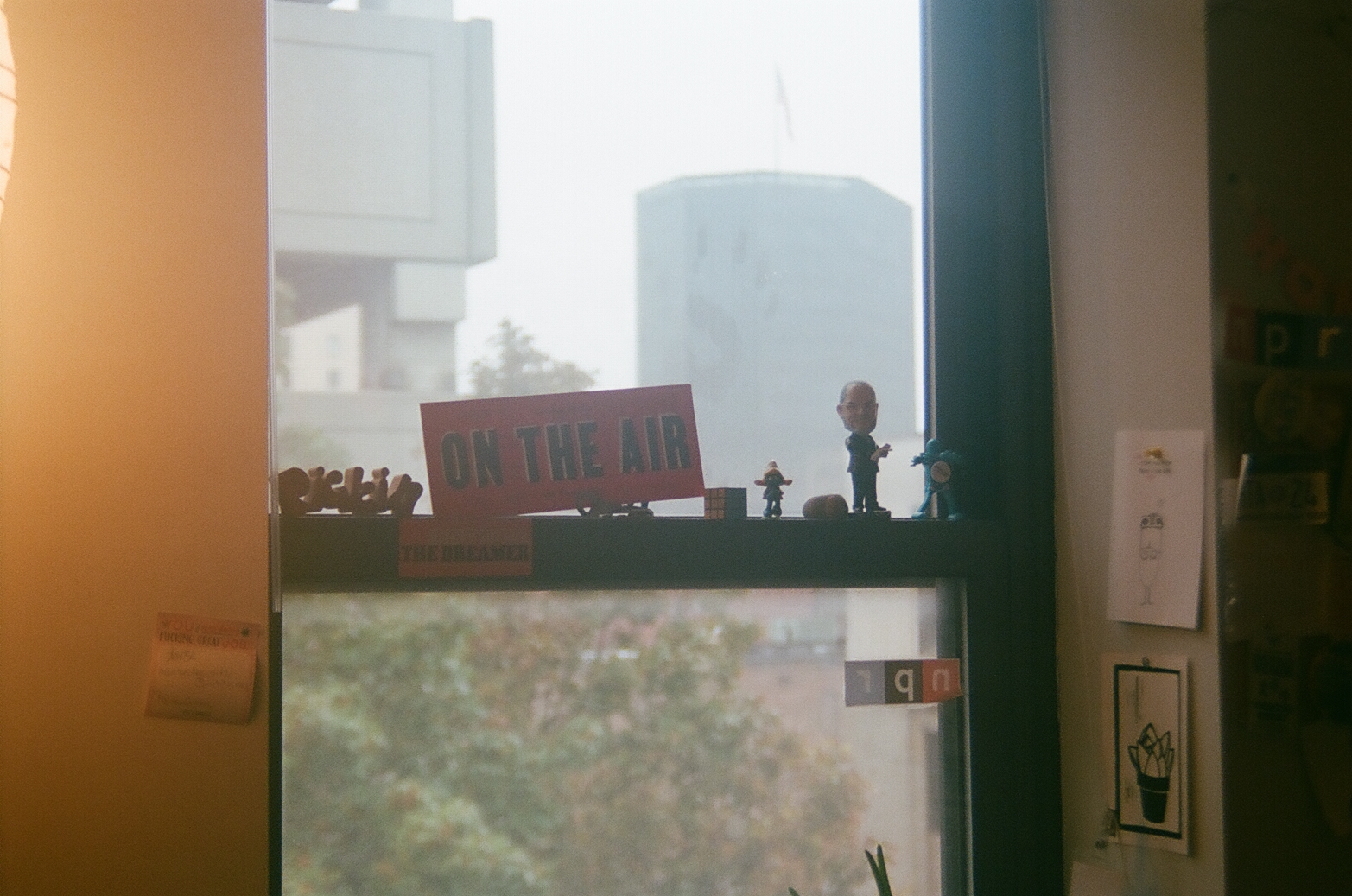
A window at West Virginia Public Broadcasting displays various radio items, including an “On the Air” sign./Brigit Benestante.
Venues, labels, and artists are doing work to help public radio chart both local and national plans to keep essential services and local culture alive, from the grassroots to the big ideas.
In July, Congress approved—and the White House signed—a rescissions package that pulls billions in previously appropriated funds from public media. The shock hit immediately: stations face budget holes, staffing cuts, and the loss of shared infrastructure that quietly kept everything humming. The near-term reality is hard. CPB’s wind-down removes not only money but also shared infrastructure: grant programs that underwrote emergency alert upgrades; education partnerships like Ready To Learn; and sector-wide work on licensing and compliance—all functions that individual stations now have to price, staff, or forego.
Stations have cut staff and collapsed schedules to save cash, while others fast-tracked record drives to compensate for lost CPB support. Classical outlets are particularly exposed: public radio accounts for the overwhelming share of classical airplay in the U.S., and several longtime services have already shrunk or gone silent.
Yet some of the people closest to the ecosystem keep pointing to what remains sturdy and what provides direction for what’s to come: the relationship between local stations, local artists, and local venues.
“I don’t think independent venues and promoters and festivals can do what they do without public radio existing,” says Stephen Parker, Executive Director of the National Independent Venue Association (NIVA). He’s talking about the nightly handoff—from an on-air spin to a ticket sold—that keeps small rooms alive.
“A lot of times, a booker at our venue will get a really interesting artist to come and the public radio station will have an interview with that artist or do a performance with that artist prior to their show and encourage people to come to the independent venue,” he says. “Because that artist has been playing on public radio, there’s a built-in customer base for that and a built-in fan base for that artist to have some sort of foothold in that community and grow their career.”
The corollary is blunt. “We lose a customer base, we lose a fan base for our venue if that marketing platform does not exist,” says Parker. “If public radio goes away or if public radio has to cut back their service or cut back their hours, it’s going to have an impact on our ability to continue to bring those audiences in.”
Parker frames it as core to the business model. “Creativity and risk-taking is really hard as an artist […] and it’s very rare that you have a space in your community or a platform in your community to take that risk,” he emphasizes. “I like to think that independent venues and public radio, we’re still that place.”
On the label side, Rob Wilcox, Promotions Director at Polyvinyl and a former WXPN intern, hears the same value and fragility in the discovery pipeline. “I am worried because these radio stations are the lifeblood for discovery for our artists,” he says. “Our bread and butter in terms of radio support is pound for pound in favor of non-commercial radio and radio that prides itself on new music discovery.”
What makes that dial matter, he adds, is who it answers to. “Noncommercial radio stations care about what their listeners care about because that is how they sustain themselves,” says Wilcox. “I’m not worried about this being the end of noncommercial radio per se, but it’s really, it is a bit of a death blow.”
Wilcox’s argument is less elegy than mechanics: underwriting instead of ads gives programmers room to risk early plays on artists who don’t yet fit a format. “It’s a throughline where the public has access to the media in a way that they themselves can help guide the trajectory of artists’ careers, in essence, radio outlets that are beholden to the people as opposed to a higher entity or higher authority. These are stations that care about what people care about,” he says.
Jessica Weber, owner of artist development/promotions firm co-sign and a co-organizer of the grassroots effort Radio Rescue, is focused on what can be done to move the people who already care, as well as how to touch people that still may not know what’s going on. “The number one question our label partners, artists and music lovers are asking us is ‘What can we do? Who do we donate to?’” she shares.
Weber has long been pressing stations to talk more about what they deliver to their communities—and in this moment, to connect that story to larger concrete actions artists and fans can take to support them. “These stations do so much. I’m always down to help folks figure out a way to develop a narrative that resonates with people,” she says.
A huge part of that is getting her partners and labels involved, organizing radio-first moments that show the love artists have for the format, like they did for the release of Sylvian Esso’s latest single “WDID.” “We were able to give their new single to radio first before it was up anywhere else,” she says of the launch, made doubly impactful now that the artist has removed their music from Spotify.
Her view of the rescission is not apocalyptic; it’s operational. “It doesn’t feel like some end of the world shit. It does feel like, “Okay, what’s next? How do we move?’” Her work with Radio Rescue has been part of that. It has a simple message: “The radio you need is not guaranteed,” which emphasizes the need for people to be active and loud about what could happen without more intervention.
She muses on what political organizers do with canvassers. “It’s all about people who feel passionate about the cause. We’ve got to find those people,” she says of the value of finding the fans in each community of their local stations and people who believe in the ideas behind Independent media. “Also, it can’t all be only on these stations to make these connections; it’s all hands on deck right now. Everyone has to play a part.”
Finding those who want to volunteer their time for public media is especially important as a picture emerges across the landscape of the music industry and its larger ecosystem of what the rescission removes and what remains. CPB’s pooled services and grants helped underwrite everything from interconnection to licensing, support that facilitated access to music and helped reduce costs to stations. On October 1, NPR and PBS launched a brand new music rights portal to provide all eligible public media stations with the information they need about the public media music licenses, replacing the original CPB portal.
But the engine of discovery is still local: programmers who take chances, bookers who listen, artists who meet audiences where they actually live. “We are the incubators for their live performance, and public radio is their incubator for recorded performance,” Parker says.
Wilcox adds the human stakes as layoffs ripple through the system. “Friends of ours are still going to get fired from those places because they have to make up for the loss,” he says. Yet even here, the case for public radio is practical, not nostalgic. “Eventually, the homogenization of media is the death knell of culture,” he says of the worry of what comes next. “[Public radio] is the place where artists can still really have that rock and roll dream of hearing themselves on the radio and having something happen because of it.”
For the music industry, the work now is to activate the people already in the circle—venues, labels, artists, and listeners—and to align programming, promotion, and development so stations can keep doing the uncommon thing they do. “This is a marathon. This isn’t a sprint,” Weber states.
For Public Radio Music Day 2025, that’s the clearest throughline: noncommercial radio still connects artists to real people in real places, and the people closest to it are already building the next scaffolding—on the air, on stage, and in the communities that make both possible.