
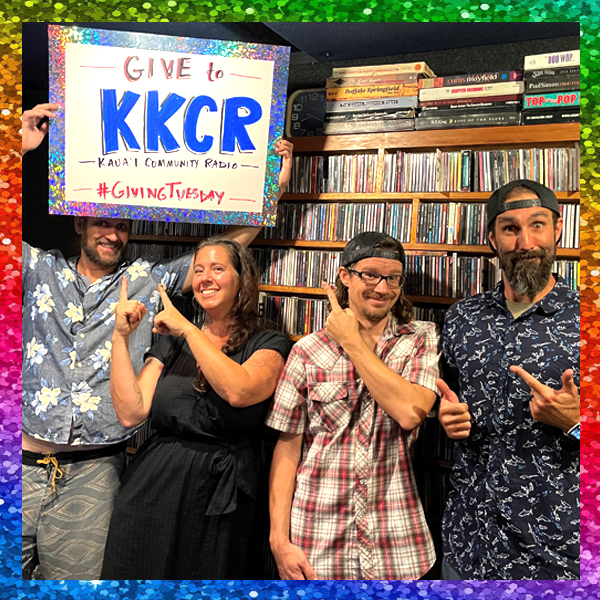
The Napali Coasters, a local band featuring KKCR staff, after they played live in studio.
From Japan to the mainland to all of Hawaii’s islands, the dozens of volunteer DJs that make up the station broadcast the small island’s sense of community far and wide
About 74,000 people live on Kauai. Last year, local radio station KKCR had 176,000 unique listeners online.
“When I think about our listenership, I think about the dudes I’m running into at the grocery store, and then I’m thinking about people across the country and the world that also listen to us as well,” Anni Caporuscio, the station’s general manager, explains.
KKCR first signed on the air in 1997. It is the only community radio station on Kauai, and for an island that’s roughly 552 square miles, that fact carries weight.
Caporuscio was first introduced to the station as a listener. She worked as a bookkeeper and landscaper on the island, sitting alone in an office with the radio on; KKCR was the only station she could get. The DJs became, in her words, “tacit friends.” She then bought a local coffee shop, and on the first day of opening, those same “friends” walked in to get coffee. “You’re from the Garden Island Bluegrass Show! You’re from the blues show – Vic the Barber!” she recalls saying. “I was like, oh my God.”
Thus began Caporuscio’s long relationship with the station: she ran the coffee shop for 15 years, served on KKCR’s board, became a DJ during the pandemic when the station was short-handed, then served as development director. About three years ago, she took on her current role as general manager. “You don’t get people that are necessarily qualified for these jobs,” she says of a feeling shared by many rural community stations. “You get the people that are willing.”
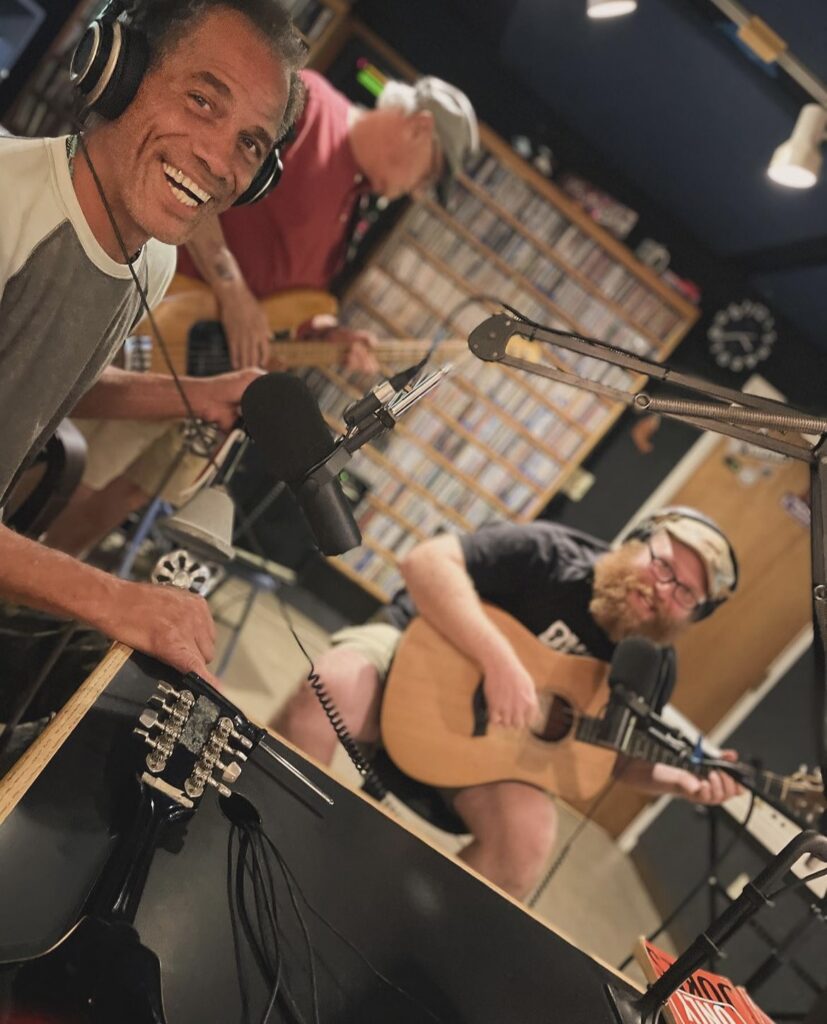
Host Tod Walker on the ‘Garden Island Bluegrass Show.’
Tod Walker has been “one of the willing” for almost as long as the station has existed. He moved to Kauai in 2001 to teach at a Waldorf School, after a family member died, bringing his record collection with him. Walker had a history in radio at the storied Los Angeles college station KXLU, so he looked up the local station upon arriving to Kauai. His first show aired that October.
Like many community DJs, his shows and playlists shifted over the years. First was The Flip Side, a late night slot playing full B-sides of jazz fusion albums. Then came The Beatbox Time Machine, a show he held for 23 years and is still best known for. After a stretch on nearby Maui, he moved back to Kauai; his current show, Supersonic Sandbox, airs every Thursday. “They know my voice, so they still think it’s my older show, and I have to tell the same old jokes,” he says.
KKCR runs on roughly 65 volunteer DJs with only three paid staff. “Each DJ has their own specialty area,” he says. “One’s really into the rare jazz and the Miles Davis, and the other one’s into Sun Ra. It’s like working at a record store basically,” says Walker. Caporuscio agrees, seeing the full scope of shows and commitment to the music and station. “They eat and breathe it,” she says.
Walker calls KKCR “basically a reverse recording studio.” Musicians come up to the station and play live on the air, sometimes as part of his show, sometimes as guests on others. “It’s usually different than what my playlist genre is,” he says. “Sometimes it’s folk, bluegrass, sometimes Hawaiian reggae, singer-songwriter.”
-
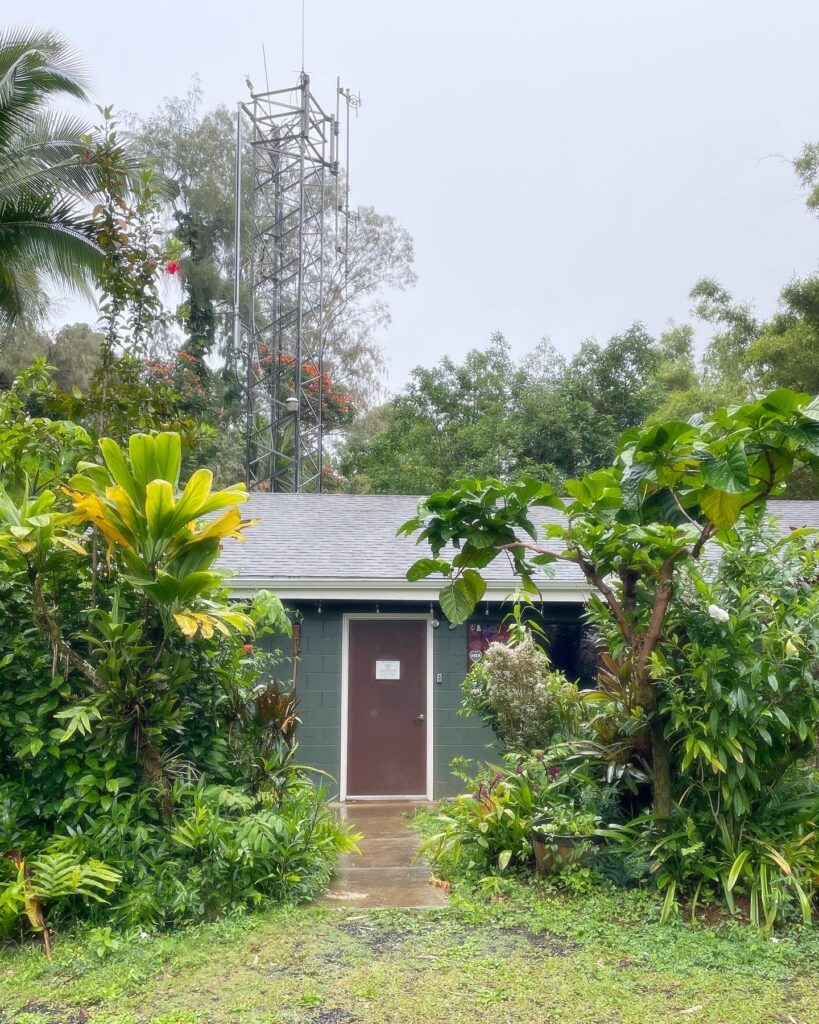
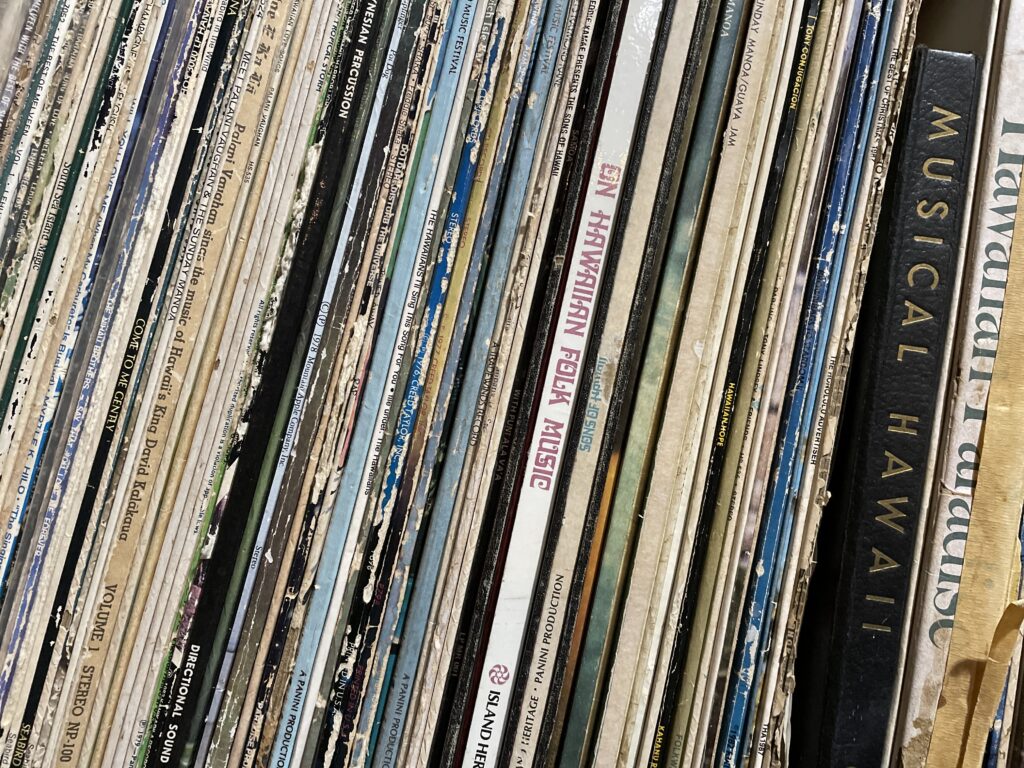
- KKCR staff lovingly call their studio the “Jungle Shack,” which visitors must drive up windy dirt roads to get to. The station has a vinyl collection of Hawaiian music.
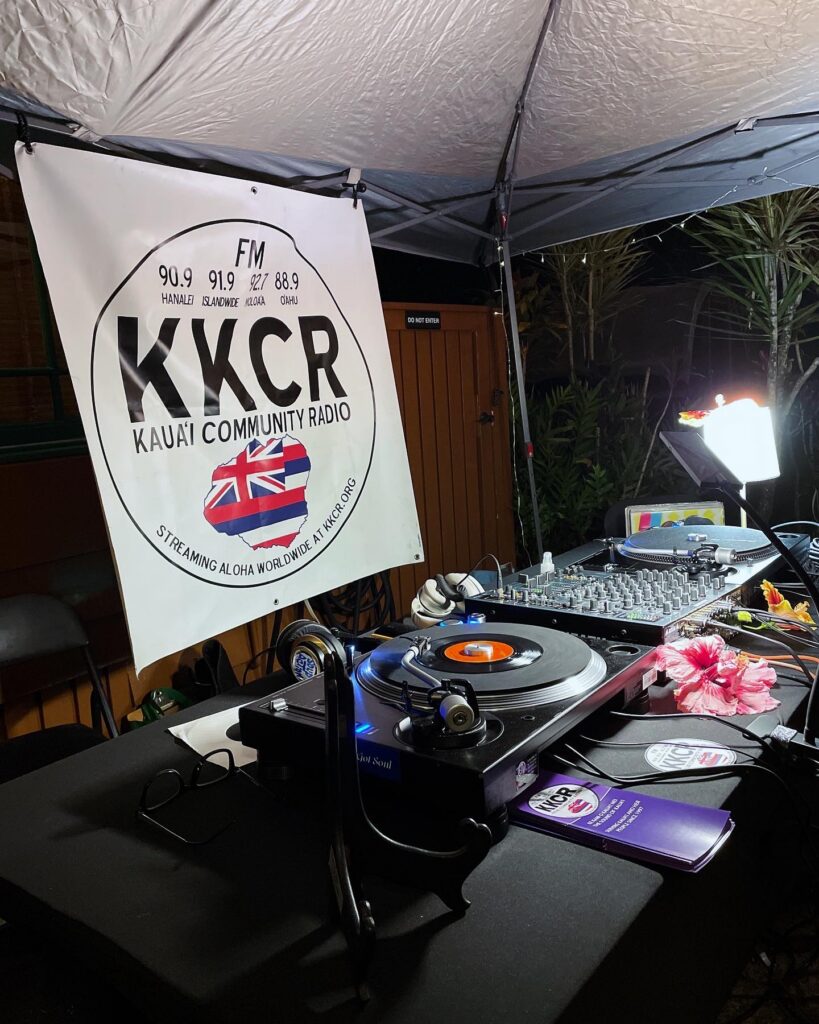
For a lot of those musicians, it’s their first time in front of a microphone. Walker walks them through it the way he’d walk a friend through anything unfamiliar. “Here’s your microphone, here’s some headphones, why don’t you throw those on real quick, see how you sound,” he says. “Don’t even worry that there’s a couple thousand people listening. It’s fine. They can’t see you.” He’s had people tell him afterward that it opened something up in them, pushed them toward more live performances. “I’ve broken a lot of Kauai artists on the air,” he says.
While the station no longer has a dedicated local music show, live local music now happens on KKCR informally, when someone’s around and willing, weaving the local scene into the station in a more freeform way. There used to be a Sunday program called Kaua’i Live, but after a new DJ took over the show, the timeslot evolved to the new host’s regular reggae show.
Off the air, Walker himself is a local musician, playing bass in a band called Animal Dream, going on 20 years now. He describes the local scene as sparse but real. “When you get a good event, the folks come out,” he says. There are blues cover bands, Americana rock cover bands, reggae bands, and a Hawaiian-reggae hybrid called Jawaiian. After COVID, several restaurants stopped staying open late, compressing gigs from an 8-to-midnight slot down to 6-to-8. Musicians adjusted. The crowds, he says, still come.
Part of the local music woven through the station is its Hawaiian programming, which carries a different kind of weight. “This is what we have. We love it. We play it,” Caporuscio says.
By the 1980s, fewer than fifty Hawaiian-speaking children remained on all the islands, and hula had nearly disappeared under decades of suppression before the Hawaiian Renaissance revived both traditions in the 1970s. Caporuscio sees the station’s commitment to Hawaiian music against that backdrop, not as a ratings strategy. “It’s important whether or not anyone’s listening,” she says.

Anni Caporuscio in the KKCR booth hosting ‘Good Times Radio’.
When asked about what keeps people on Kauai, both Walker and Caporuscio landed in roughly the same place. “There’s no one that hates Kauai,” Caporuscio says. Walker traces it to something specific about the island’s culture. “The land is perpetuated through righteousness, that’s the state motto,” he says. “There’s a lot of love here that everyone works to protect.”
That sense extends to listeners who aren’t on the island at all. Walker has a group of regular listeners from Canada who text in every week. “It’s giving the international listeners and the local listeners the same thing, which is a positive entertainment option,” he says. He thinks about someone in Texas hearing the show and telling a friend their favorite station is in Hawaii. “It’s just spreading the aloha,” he says.