
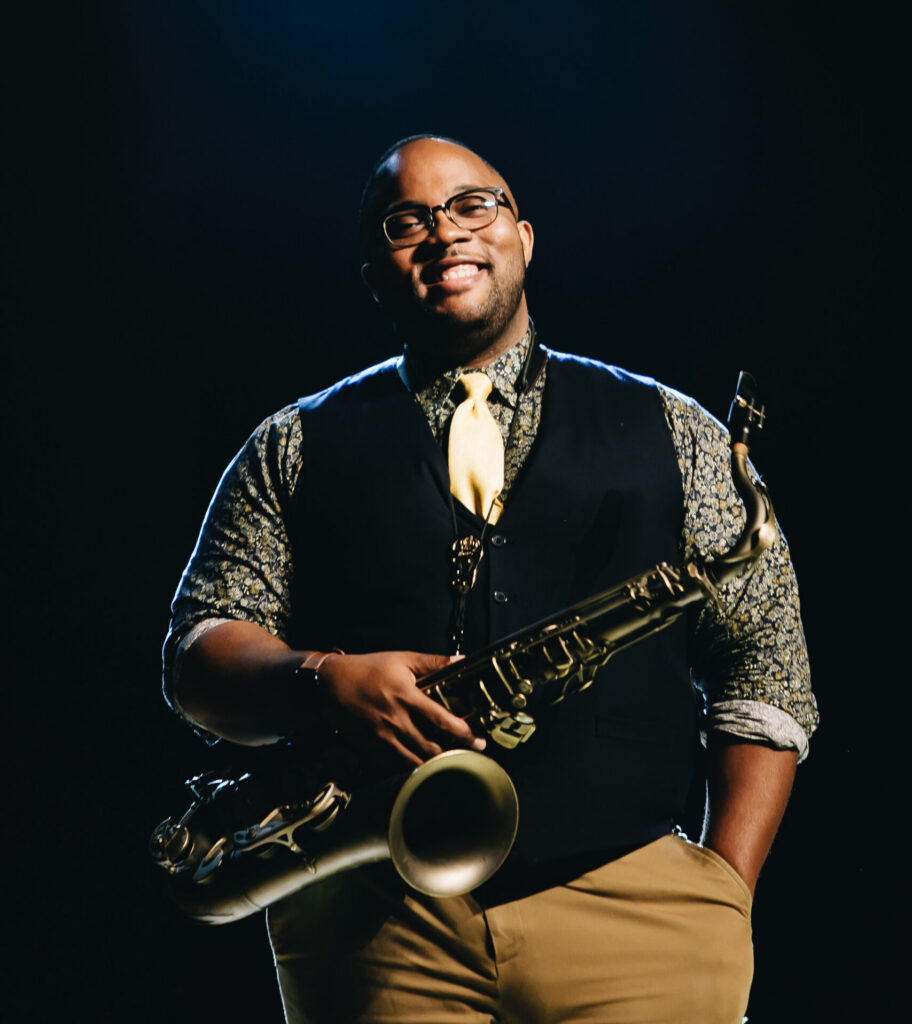
Along with serving as Delmarva’s Music Director, Harvey is an acclaimed saxophonist, composer, and band leader whose work has drawn praise from DownBeat Magazine and All About Jazz.
Eight months into a newly created role, a saxophonist and educator shapes the sound of three stations on Maryland’s Eastern Shore.
Stephen Philip Harvey may be, by his own admission, “the greenest” music director to walk into the job. “I talked about my role in a class yesterday as a guest speaker and I was like, ‘Yeah, I’m eight months into the job,'” he says. “And it was an originated position for [the organization]. So we’re still figuring it out.” But in those eight months, Harvey has already helped reshape the sound and scope of one of Maryland’s most distinctive public radio operations.
Harvey joined Delmarva Public Media in July 2025 as its first music director in two years, overseeing the musical direction of all three of the organization’s stations: WESM 91.3 (Jazz, Blues, and NPR News), WSCL 89.5 (Classical Delmarva), and WSDL 90.7 (Rhythm & News). The three-station collaboration between Salisbury University and the University of Maryland Eastern Shore serves the Delmarva Peninsula, a largely rural stretch of Atlantic coastline shared by Delaware, Maryland, and Virginia, and Harvey describes his reimagined role as threefold: curating and digitizing the music library, producing shows and segments, and developing the organization as a presenting partner for live performances.
He is an acclaimed saxophonist, composer, and band leader whose work has drawn praise from DownBeat Magazine and All About Jazz. Harvey also runs his own label, Hidden Cinema Records. It was that musical life that brought him to the station.
Two years ago, General Manager Judy Diaz caught him at a gig and approached him afterward. “She was like, ‘Hey, you’re a really great speaker and obviously play a lot of jazz music. Do you want to apply for a job?'” Harvey recalls. “And I was like, ‘I already applied for this job!'” He had been passed over for an on-air-host-only posting because he lacked broadcast experience, but Diaz had recently broadened the qualifications and position to the Music Director role he is in today.
For Harvey, Tuesdays and Wednesdays are his heaviest days in the station. Mornings start around 9:30, and the first hour belongs to the music library. “One of the greatest parts about the curation and digitization of the library is I’ve never gotten paid to listen to music before,” he says.
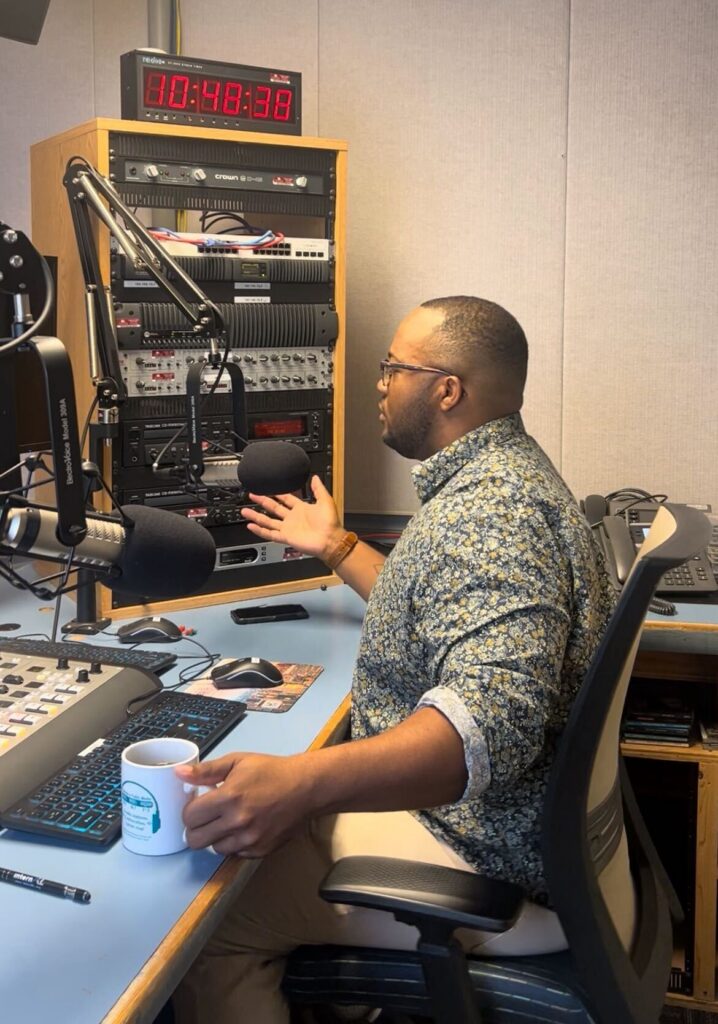
For Harvey, Tuesdays and Wednesdays are his heaviest days in the station. Mornings start around 9:30.
CDs arrive steadily, often with a one-sheet with key information about the release, but Harvey digs deeper, researching artists and tracing their back catalogs. “In the world of jazz, you’ve listened to people, but you did not know that you listened to them if you did not look at the liner notes,” he says. That research feeds his weekly show, Jazz Horizons, an hour-long program on new releases airing Wednesdays at noon on WESM.
By late morning, Harvey moves into production, editing segments and recording voiceovers. He also produces Jazz Origins, a segment exploring landmark albums from the hard bop era and beyond, and conducts interviews with visiting artists that air on a flexible schedule.
One thing Harvey did not anticipate is how much of the job involves talking and responding to radio promoters. Sometimes it can be daunting; a recent Tuesday brought 24 releases from a single promoter. “Communication with radio promoters is a big portion of this job, which I did not anticipate,” he says.
As a working musician who has promoted his own records, he had only interacted with the promotion side as an artist. Sitting on the other end opened up a new perspective. “This is the first time I did radio promotion because I started working in radio,” he says. “I was like, ‘Oh, this is kind of cool. I should do more of this. Why am I not promoting all the radio if I’m working in radio?'”
Harvey’s philosophy on rotation is notable for its restraint. He does not dictate playlists to his live hosts. Instead, he provides stacks of new releases with suggested tracks and trusts their instincts. “If I’m not being the live host, I don’t want to curate their live hosting for them,” he says.
He hopes to eventually use automated programming blocks for heavier rotation, giving promoters the spins they seek while preserving host autonomy. “We are not robbing these great hosts of their autonomy to decide what they want to play.”
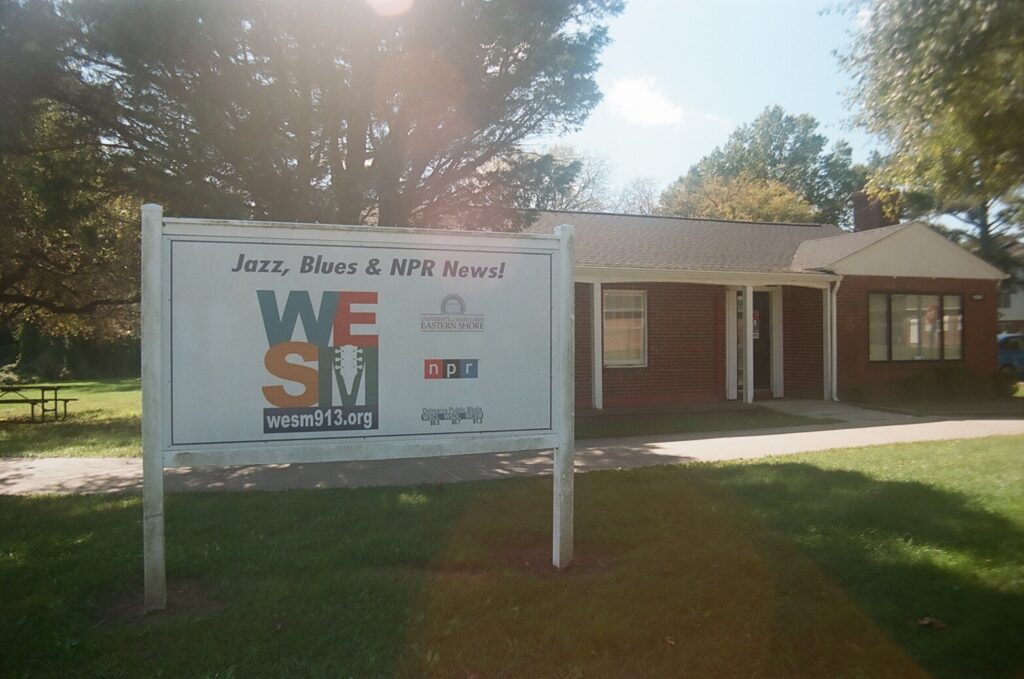
Delmarva Public Media station WESM is located on the University of Maryland Eastern Shore campus in Princess Anne, MD.
That philosophy is undergirded by the fact that the staff at Delmarva Public Media is largely composed of musicians. Bryan Russo, Delmarva Public Media’s chief creative officer and de facto programming director, is a blues musician and band leader. Jenny O’Connor, the arts and culture reporter, plays in the pop-punk band Daybloom.
“I’d be really frustrated if it was like, I’m the music director and then maybe two hosts, and we were the only ones who cared about the quality of music or the breadth of music,” Harvey says.
Since arriving, Harvey has pushed to update the station’s sound with more contemporary jazz while honoring the catalog that built its audience. “We’re updating but not abandoning,” he says. “We’re adding in a newer sound, but not necessarily abandoning all of the history that was there and making the space for all of it.”
He also launched an arts and culture calendar for the region. “There was no regional arts calendar to say, ‘Hey, here’s all the arts offerings that we’re having,'” he says. It started as music-only and quickly grew.
Harvey still teaches saxophone and clarinet as an adjunct at Salisbury University and lectures online at Youngstown State University. His performances now carry the station’s identity with them.
At the Maryland Folk Festival in Salisbury, he helped host the live broadcast, and the crossover surprised him. “I’m a real person here who is presenting music, but then partnering to present music,” he says. Old students showed up in the crowd and heard NPR for the first time.
What ties it together is the chance to channel years of musical training into something beyond the classroom. “There’s a lot of information in your brain that you just don’t remember that other people don’t know,” he says. “All the training and education and just the vocation of learning this music and playing this music and being inspired by all these artists and actually reading about them and being a part of it is completely different than just being a fan.”
The station sounds different than it did before he arrived. “It makes me feel like, oh, we are really right now,” he says, “rather than in the past.”
This is part of the noncomMUSIC Alliance’s A Day in the Life series, profiling key roles in public radio. Previous installments have featured a radio promoter, an intern, a program director, and a general manager.