
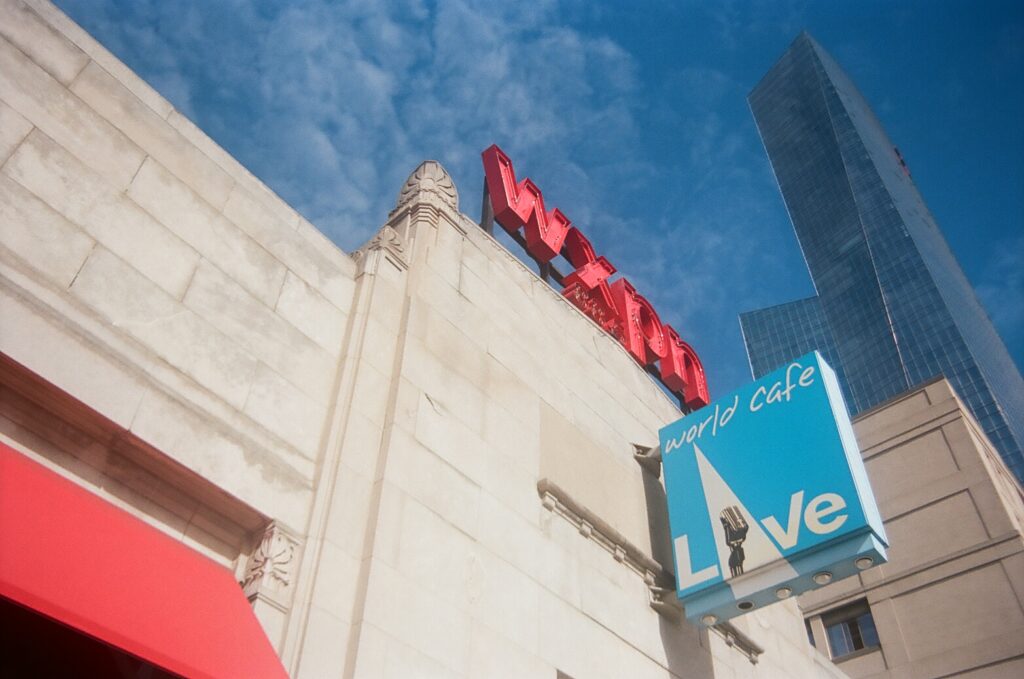
Public Radio Music Day spotlights a public media ecosystem amidst a time of huge change, and the shared work of keeping music discovery, curation, performance, and community essential.
The July 2025 rescission of billions in previously approved spending and appropriations that had long stabilized public media was felt by stations immediately. First came the biggest news: the Corporation for Public Broadcasting (CPB) announced an orderly wind-down by October 1. With that, stations lost not just financial support but foundational scaffolding in one stroke.
Public Radio Music Day this year arrives as a snapshot of what is happening and what can be done: a nationwide system reconfiguring in public view, local, independent stations and national organizations adjusting in real time, and partners across arts and community organizations understanding their role in this new reality for public media. For station leaders, the day comes during a period of explanation, reframing, and recommitment.
At WXPN in Philadelphia, General Manager Roger LaMay says audience education comes first, since many listeners had not considered the federal piece of a listener-supported system. “There was a heightened awareness that we are in fact part of the NPR and public media system in a way that hadn’t totally permeated before,” LaMay says, adding that WXPN has “a really loyal and protective audience […] who were well ready to rise up against anything that would threaten their beloved stations.”
LaMay emphasizes music over politics and describes a line that became fund-drive shorthand after a live test from the stage. “They can take away our funding, but they can’t silence the music,” he says, noting the “visceral, powerful response” it draws and how the phrase now anchors membership messaging. He also outlines a near-term plan to invest — artist development, marketing, PR, and digital — so impact, audience and revenue can grow in parallel. “We’re […] raising our investment,” he says. “If we can do that, then we may be able to come out of this period of time stronger than we went in.”
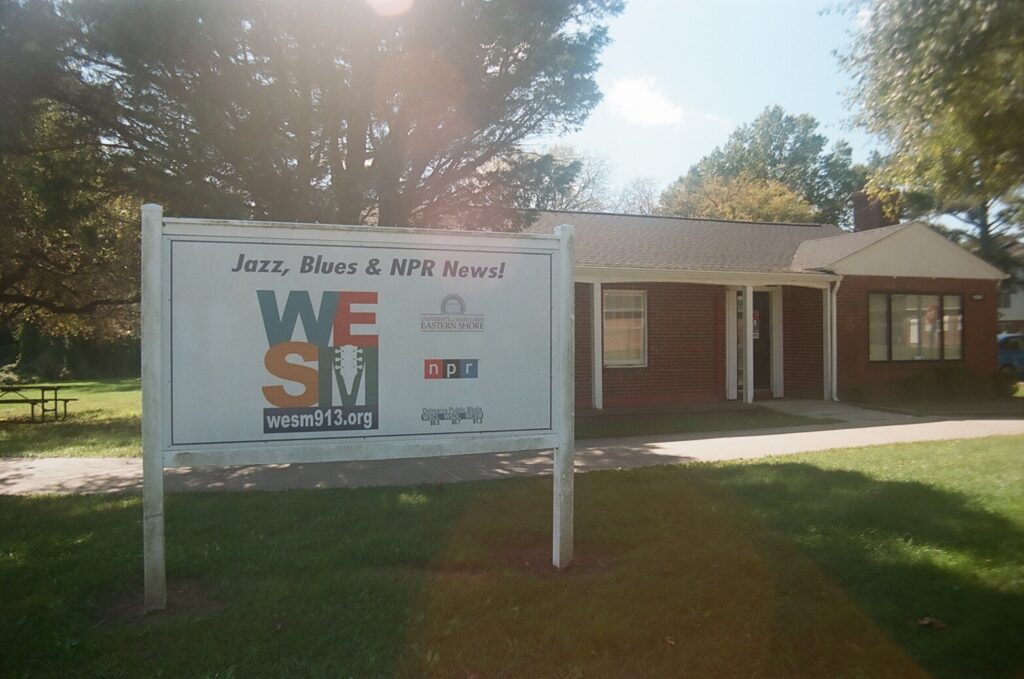
Delmarva Public Media’s WESM is located on the University of Maryland Eastern Shore campus in Princess Anne, MD.
On the Delmarva Peninsula, Judy Diaz, General Manager of Delmarva Public Media which includes stations WESM, WSDL, and WSCL, describes brisk adaptation, both to cut costs and to create more local value. “We started to look at our expenses and what can we trim,” Diaz says, explaining that the team “started changing some of our programming [and] doing more ourselves, including a lot more of our own local programming.”
Diaz points to an in-house pipeline that expands coverage and attracts donor interest. “We created something called Intergenerational Beats, where we pair a seasoned journalist with a student who wants to be a journalist,” she says, adding that “people like to support content that also has a student involved.”
Philanthropy efforts have stepped up nationally. In August, a coalition of major foundations committed $36.5 million, including $26.5 million for a Public Media Bridge Fund managed by Public Media Company and seeded by the Schmidt Family Foundation, with additional participation by Knight and MacArthur among others. For Diaz, she is looking at opportunities like these kinds of grants as an incredibly helpful opportunity on top of the Delmarva-developed programs.
Diaz notes that bridge support buys time, but not forever. “It’s really nice to have this additional funding over the next two years for us to get it right,” she says. “It’s year three that I’m really looking at. That’s when we have to be completely independent.” She also summarizes how the station communicated the moment over the summer. “We made sure that people knew that it did affect us, but that we have a plan to stabilize,” she says. “We’re confident with that plan, but it does rely on our community increasing support.”
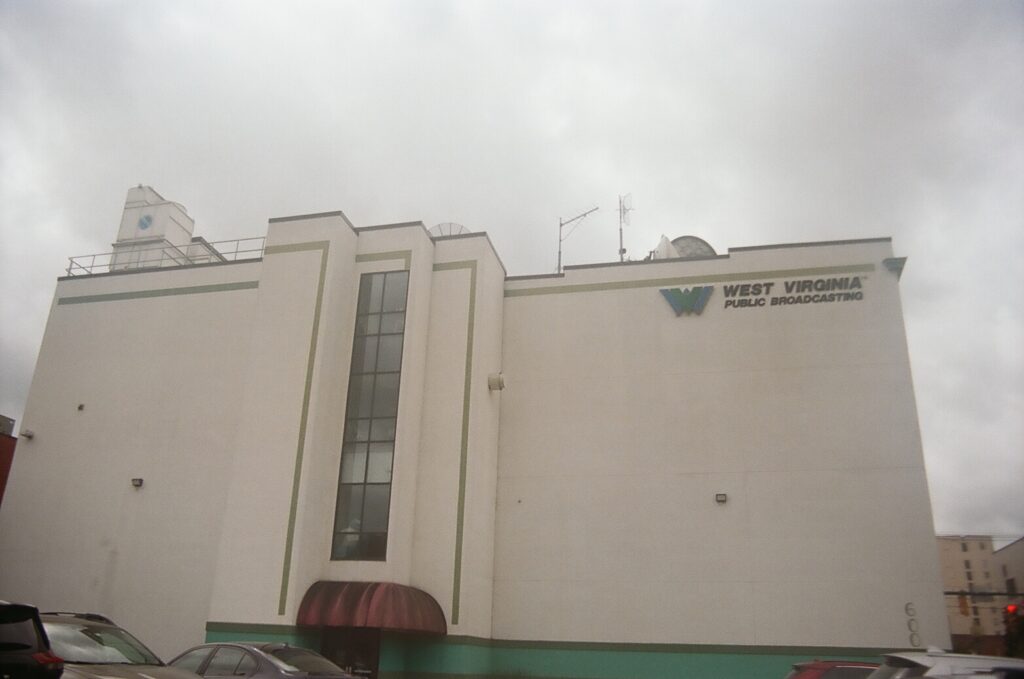
West Virginia Public Broadcasting in Charleston, WV.
In West Virginia, the network approach is visible on stage, on air, and in the city’s visitor economy. Adam Harris, Executive Producer of Mountain Stage from West Virginia Public Broadcasting (WVPB), describes the discipline of a small team that produces both live events and a national program. “I like to tell my staff, I’ll let you know when to panic. Until then, we have work to do,” Harris says.
“We have shows contracted through the middle of next year.” He frames the show’s continuity this way. “There’s always another show,” Harris says, also pointing to what makes the format singular, the live audience that shows up at each taping. “Their reaction is what makes our show unique […] and when that relationship is firing on all cylinders, you really can’t beat it.”
Tim Brady, President and CEO of the Charleston Convention and Visitors Bureau, links those nights to sense of place and civic identity. “For folks here in Charleston, [Mountain Stage] is a point of pride,” Brady says, calling the underwriting relationship a natural fit. “Tourism marketing is all storytelling.” For him, and the city, public media offers a relationship that stays strong no matter what happens with outside funding and a partnership they don’t see changing any time soon.
With 96% of classical music played on public radio, the format stands to be hit hardest by the rescission, and the wider ecosystems that the stations support are also bracing for the turbulence. Maurice Cohn, Conductor and Music Director of the West Virginia Symphony, is eager to underscore why local hosting matters. “Music at its core has to be about communicating,” Cohn says.
WVPB airs the orchestra often, which means something to the area. “You are hearing [Classical Music host] Matt [Jackfert] talk about music as a West Virginian to other West Virginians,” Cohn says. “I think that that personal connection to the music is essential.”
Across conversations, a common pattern emerges: explain the stakes without alarmism; invite audiences, artists, and civic partners into the work; and double down on the value only public-service music outlets can create.

A band performs during WXPN’s Free at Noon concert.
LaMay summarizes WXPN’s posture as “about music, musical discovery and community,” paired with near-term investment to grow through the crisis. Diaz formalizes a newsroom-student pipeline and increases local production to meet the moment and give donors concrete outcomes to back. Harris ties the show’s future to a specific reciprocal energy with its audience. “You really can’t beat it,” Harris says, while keeping teams focused on the next date, the next set, the next broadcast.
This year’s Public Radio Music Day is about all the ways the public radio ecosystems, from labels, promoters, venues coordinating with stations to new opportunities inside and out of stations are aligning to keep public media strong. Its tagline this year, “Live. Local. Essential” sums up how a lot of people across the industry are feeling now, with a hopeful eye towards the future.
As LaMay puts it, disruption is painful, but “there’s an opportunity for a lot of good things,” The work is immediate and concrete, and the horizon leaves room for reinvention. For many, that’s what’s driving them, even when faced with a crisis: a chance to come out stronger than before.