
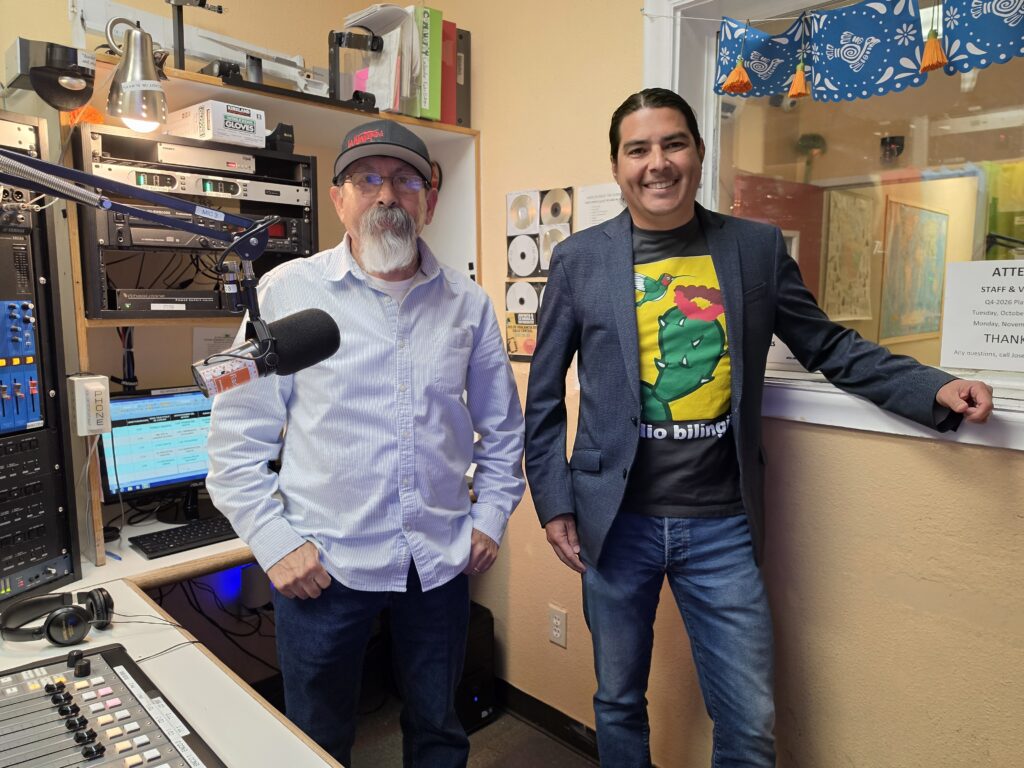
Rodríguez and Morán pose in a Radio Bilingüe studio.
Started by farmworkers and activists in Fresno, CA, the country’s largest Latino public radio network still reflects a sense of home for those listening
When Sam Rodríguez pulled Tex-Mex albums off the shelf at the Spanish-language stations where he worked as a teenager in California’s San Joaquin Valley, he’d sometimes find a little note waiting for him: Do not play Tex-Mex music.
Radio Bilingüe was different. Rodríguez arrived at the network in the summer of 1979 and helped start the mariachi, Tejano and norteño shows that still anchor its schedule.
Founded in 1976 by farmworkers, activists, artists and teachers, Radio Bilingüe has grown into the country’s largest Latino public radio network, with stations and affiliates carrying its programs from the Rio Grande Valley to Salt Lake City.
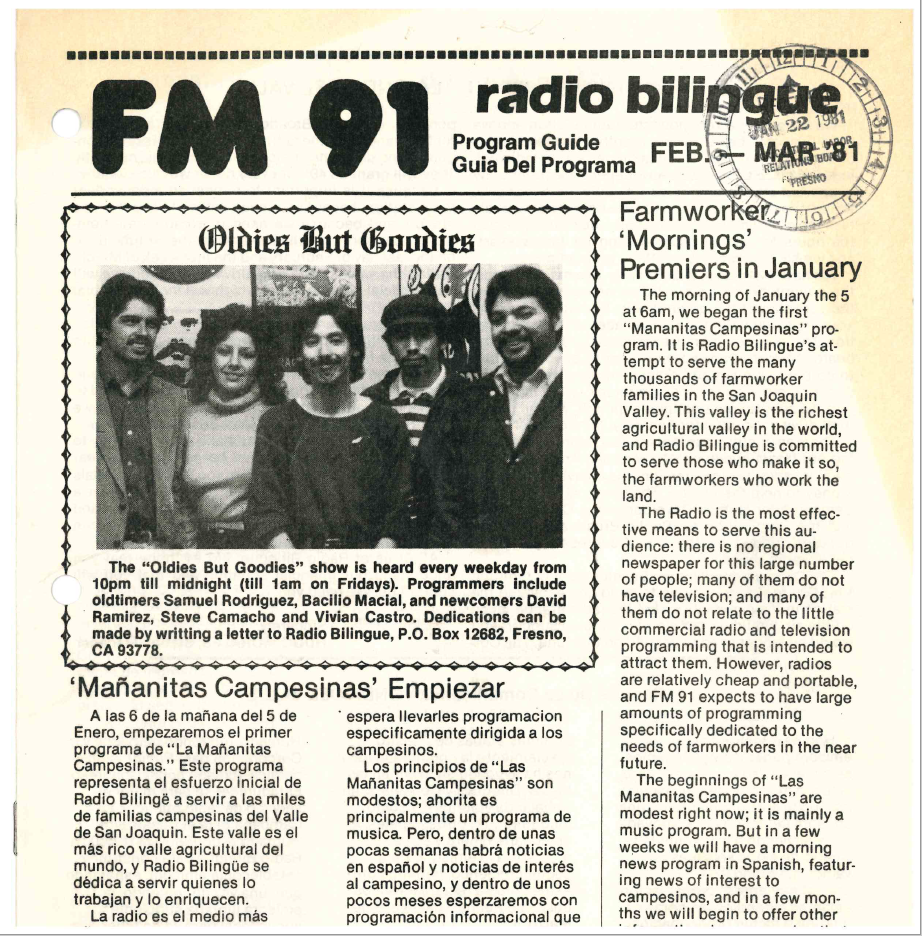
A clipping from Radio Bilingüe’s program guide newsletter in 1981. Sam Rodríguez is featured in the picture.
José Morán, its director of operations and broadcasting, first found Radio Bilingüe as a high school kid phoning in requests for “rock en español.” Both Morán and Rodríguez came to the microphone the way many of its listeners come to the radio, through the music they grew up with.
Rodríguez was born in Texas’s Rio Grande Valley and grew up in the San Joaquin Valley, working the fields with his parents alongside other bilingual families who had followed the harvests west from Texas.
New groups of farmworkers brought different styles of music to the stations that broadcast to them. Some of the valley’s radio announcers came from Texas too, and they played Flaco Jiménez and conjunto. Another crew from Mexico then brought its own taste, and the Tejano music faded from the air. Rodríguez, who had his FCC license as a teenager, was working weekends at those stations by 1976.
At Radio Bilingüe in 1979, “they were still hammering and putting equipment on the air,” says Rodríguez. The network ran tests that January and signed on in the summer of 1980. The shows he started then, Mañanitas con Mariachi, Onda Tejana, Arriba el Norte and Ritmos del Pueblo, are all still on the air. His first program director wanted a quieter, public radio sound.
“I go, ‘That’s not the way you’re going to get the audience, man. You’re going to push them away,'” he says. “Somehow he said, ‘All right, go ahead, do it your way.'”
The approach stuck. “I feel that a lot of these programmers here, they don’t sound like a public radio station,” he says. “They’re more free. You can communicate. They feel like, ‘Hey, you’re one of us.'”
Some commercial stations had wanted him to strictly program in Spanish. At Radio Bilingüe, he could move between languages the way his listeners did. “Hey, this is it. It’s bilingual, and I like it,” he remembers.
Rodríguez left in 1981 to finish school and spent nearly two decades in other jobs, including commercial radio and detailing cars. “When I was working at the dealership, I would listen to the Tejano show that I started,” he says. He came back as a volunteer in 1999 and joined the staff in 2000.
José Morán started listening in 1992, a year after his family moved from Jalisco, Mexico, when he was 14. A friend pointed him to Radio Bilingüe’s rock en español and Latin alternative shows, and he tuned in on Monday and Tuesday nights while doing his homework.
“I was one of those listeners that always requested songs,” says Morán. “I will call them every week and request.”
He and a friend got close enough to the volunteer hosts to invite them to a house party at his mom’s place, and the hosts invited them back to answer phones. After graduating from high school in 1995, he started volunteering and learned to edit on reel-to-reel, “using the tape and the little blade to cut the tape.”
His love of physical media came from his mother, who came home from her housekeeping job on Saturday nights with a new Juan Gabriel or José José record to play while she cleaned on Sundays. “We always had a turntable at the house,” he says. It started something for him: he now owns more than 6,000 CDs and about 1,000 records, and plays bass in a Fresno punk-ska band.
Morán joined the staff in 2010 as grant manager for a broadband awareness campaign. He now oversees what goes on the air.
Arriba el Norte, the weekday afternoon norteño show, is one of the network’s most popular programs. Morán pushes its hosts to mix contemporary groups in with the classics. There are limits.
“We keep it clean,” he says. “We don’t play music that glorifies drug use or trafficking, for example.” Lyrics about domestic violence are out too. For staff hosts, he also asks them to set aside five hours of every 40-hour work week for one assignment to broaden their tastes. “Listen to new music, listen to new music, and play that new music on air as well,” he says.
“You come for the music, you stay for the news,” says Morán, repeating a saying around the station. Between the music, shows run public affairs programs on health and immigration services, the national call-in show Línea Abierta, and programming in Mixteco and Triqui for Indigenous Mexican listeners.
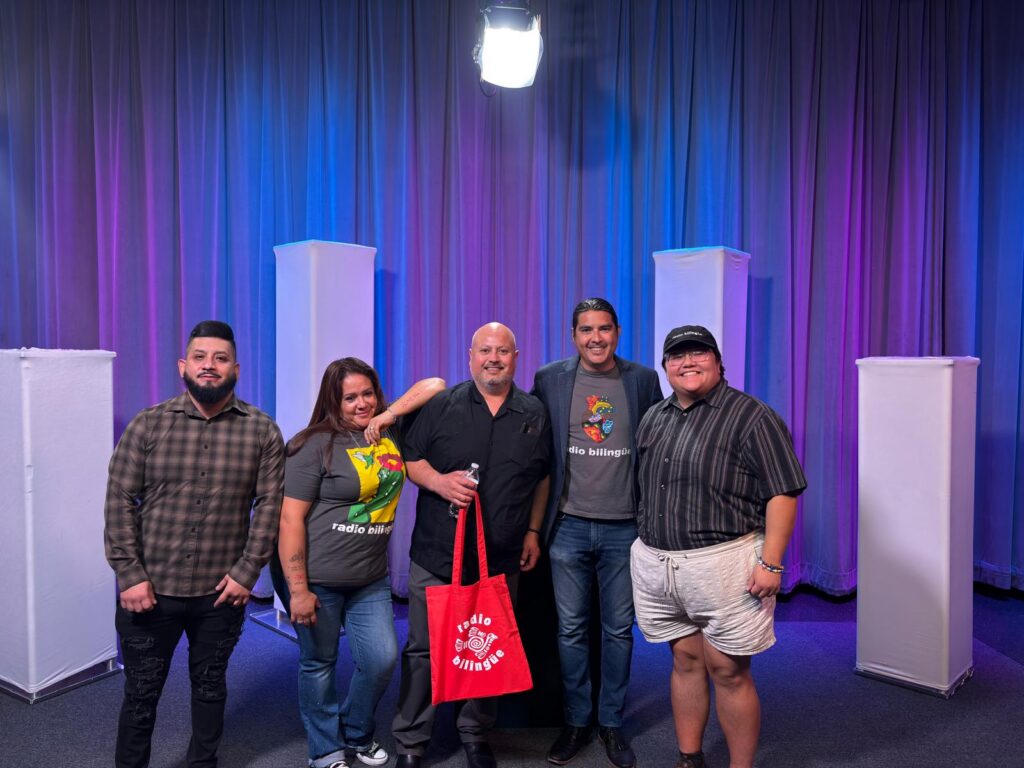
Some of what Radio Bilingüe airs would be hard to find even in Mexico. Mariachis play in plazas in every town there, Morán says, but “it’s unheard of that you will listen to any mariachi music over the radio in Mexico.” Mañanitas con Mariachi, the show Rodríguez started in 1980, runs from 6 to 9 every morning.
Across the schedule hosts pick immigrant songs that reflect a sense of shared identity across communities, like Los Tigres del Norte’s “América,” recorded with Residente of Calle 13. “We are just like birds. We migrate whenever we feel more comfortable, we feel more safe,” Morán says. “If we have the wings, the capacity to be able to do those things, we’ll move.”
This year’s Public Radio Music Day theme is “Sounds Like Home.” “Just to me personally, it brings me back to Mexico and listening to mariachi in the streets when I was a kid,” says Morán. At holidays with his uncles, aunts and cousins, music played behind the grown-ups’ conversations while the kids danced. “So it was a happy place for everyone,” he says.
Rodríguez hears it from his callers. “I get listeners that call me up and say, ‘You know what? That song reminded me of when I was young, or this song reminded me of when I was growing up at a certain area, or reminds me of my girlfriend or my husband or so forth or a family member. It brings me tears and so forth,'” he says.