
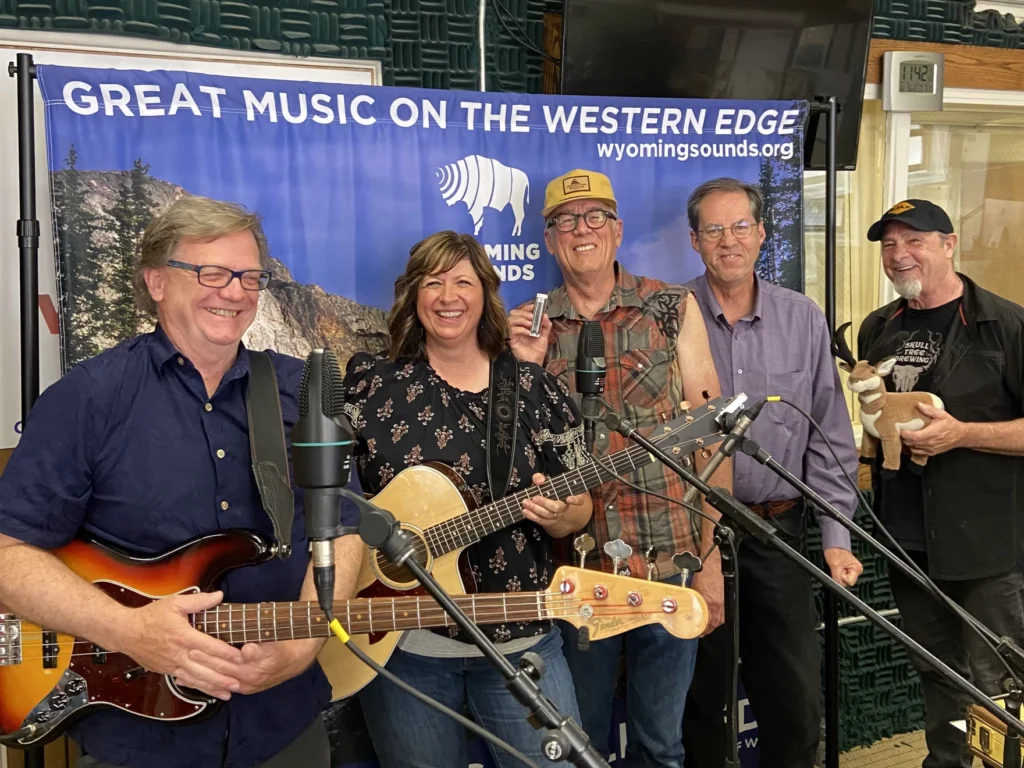
A Band Named Sue and Grady Kirkpatrick during a Studio Session for Wyoming Sounds (Credit: WPM)
Wyoming Public Media’s music program has spent ten years creating connections that make the nation’s least populated state feel like “one big local scene.”
UPDATE: The Wyoming state legislature passed a budget on March 2, 2026, that included Wyoming Public Media’s full appropriation of $1.7 million. This came after several weeks of amendments in the House and Senate of the Wyoming legislature, in addition to negotiations between the two chambers. Lawmakers heard from numerous Wyoming residents calling on the legislature to restore funding for Wyoming Public Media, underscoring the depth of support for the organization and its services throughout the state.
Every weekday morning at 9 a.m., Wyoming Public Media’s Wyoming Sounds fills the airwaves with an eclectic mix of Americana, folk, and contemporary music — with Wyoming artists woven throughout. For a decade, the program has created a musical community from Casper to Jackson, Lander to Laramie and all across the state, connecting musicians with audiences and artists with each other.
“Wyoming is unique,” says Suzanna Morrison, whose band A Band Named Sue topped Wyoming Sounds’ listener picks for best Wyoming releases in 2025. “If you’re going to listen to Wyoming Public Radio, you’re going to hear a friend. Musicians across the state, we are a tight-knit community. Where else could you turn on a station and you’re going to hear your friend, or you’re going to discover a new potential friend? Nowhere else.”
This sense of connection defines Wyoming Sounds. The show airs weekdays from 9 a.m. to noon on Wyoming Public Media’s main channel, but also operates as a 24/7 music service. Program Director and host Grady Kirkpatrick has guided the show since 2016, when it evolved from a post-morning news music block called “Morning Music” into something distinctly Wyoming.
“The idea is with the music and all our local news reporters, [to] just connect the dots with all the small towns in Wyoming through the music,” Kirkpatrick says. “We include those Wyoming artists with a kind of a Triple A-Americana mix.”
For Kirkpatrick, who came to Wyoming from working in public radio in Kentucky, the show represents a different kind of music programming. “Wyoming musicians aren’t necessarily all what you would classify under the Americana sound,” he says, “so it’s kind of nice that we’ve got leeway to put in a lot of different styles and music.”
The program also produces Studio Sessions, live in-studio performances that often mark crucial milestones for Wyoming artists. Adam Kirkpatrick, founding member of The Tinderwoods, which came in second on the 2025 listener picks, remembers his band’s first airplay vividly. “I listened to it live on a job site with my crew members cheering on. It’s so lovely.”
His band’s debut EP is titled “Small Town Long Streets” — former Wyoming Senator Alan Simpson’s phrase describing the state’s paradox: massive in size but intimate in community. “We’re like 97,000 square miles,” Kirkpatrick explains. “We’re a big state, but we’re a close state. Performing in Wyoming is one big local scene.”
Wyoming Sounds amplifies these connections. Morrison notes the program helped A Band Named Sue book shows in towns they’d never played. “We had a lot more people looking at our Facebook and our Instagram and DMing us and inviting us to play and connect,” she says. “That was a big deal for us.”
For Grady Kirkpatrick, watching this community develop over the past decade has been remarkable. “When I go to these events in person and people come up to me, it’s pretty humbling,” he says. “They’re almost crying, actually. It’s pretty powerful.” He remembers the response when the show launched. “It was so positive that it blew me away, because there was kind of a legacy longtime host here that everybody loved.”
Now, that community faces an uncertain future. Wyoming’s Joint Appropriations Committee voted in January 2026 to cut state funding to the University of Wyoming, which houses Wyoming Public Media. If those cuts proceed, the station would lose the producer-programmer position that makes Wyoming Sounds possible as a daily, curated program.
General Manager of Wyoming Public Media Christina Kuzmych understands what the show means to Wyoming’s music scene. “People love this show and the service,” she says. “Some listeners are Wyoming Sounds listeners only. They have no idea that Wyoming Sounds is a public radio production.” The station deliberately chose not to include news at the top of the hour.
The strategy worked. While Nielsen ratings prove unreliable for Wyoming, other metrics tell the story. “We really base our thinking on our Google analytics, what we get online,” Kuzmych says. “We look at our streaming because that we know is objective.”
More importantly, she sees the show’s impact in how it’s mobilized the community. Morrison, Adam Kirkpatrick, and Cory McDaniel organized concerts to celebrate Wyoming Sounds and raise awareness about funding threats.
“We’re playing this show. Come down and email your representatives,” Adam Kirkpatrick implores. “If you dig this, reach out to the people that are supposed to be representing you.”
Wyoming musicians are showing out in force to support the station. Centennial musician JShogren played during Wyoming Public Media’s 60th Anniversary celebration at the state capitol on February 17, 2026, and just released “Country Music Just Sounds Better (on Wyoming Public Radio)” in support of the station.
The Wyoming Singer-Songwriters Association is encouraging people to reach out to their local lawmakers to support Wyoming Sounds: “You need to know with all seriousness and sincerity that Wyoming Sounds does more than any organization, festival, venue, promoter, certainly any other radio station to promote and share Wyoming Music from all genres and all artist backgrounds.”
For artists depending on the Wyoming Sounds, the potential loss feels personal. “It would be a major hit,” Adam Kirkpatrick says. “You’re taking away a thing that’s unifying to the people of the state.”
Morrison puts it more directly. “At what point are we just going to put our foot down as members of this amazing state? People are more important than capital – period. This is really cutting out your community connections. We’re not about that. Wyoming has never been about that.”
So, what is Wyoming about? And what is a “Wyoming sound”? According to Morrison, a Wyoming sound is “authentic creativity outside the parameters of any defined genre,” shaped by “influences of authentic living.” Adam Kirkpatrick suggests it’s less about musical style than lyrical content — “songs that tell Wyoming stories of which there are many and plenty.” Grady Kirkpatrick sees the show celebrating this diversity, noting the show’s “leeway to put in a lot of different styles and music” while staying true to Wyoming’s character.
As Rural Voices Day approaches on March 4, Wyoming Sounds stands as testament to what rural public radio achieves when it commits to local culture. The show doesn’t just broadcast music; it creates community, fosters artistic development, and provides infrastructure for a dispersed music scene to function as a cohesive whole.
“Success is not measured based on how much is in your bank account and how many people are listening,” Morrison says. “Success is how connected you are to those around you. And do they recognize it? Because those connections don’t happen by accident. They’re intentional.”
For ten years, Wyoming Sounds has made those connections intentionally, consistently, and with care. Whether it survives another decade depends on decisions being made in the Wyoming State Capitol. But the music — and the community it has built — endures for now, every weekday morning from 9 to noon, connecting a small town with very long streets.