
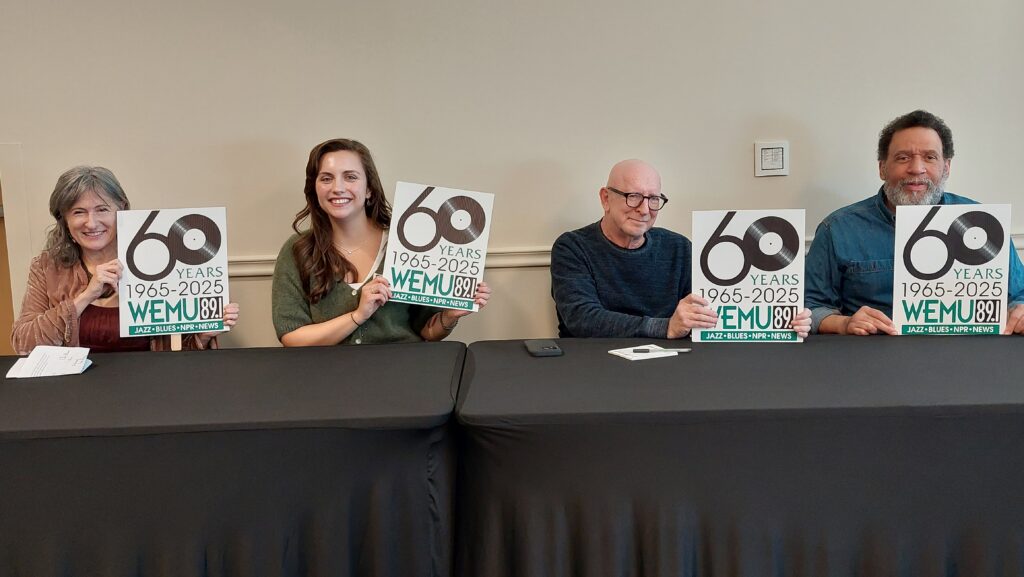
WEMU’s 2025 Public Radio Music Day panel, featuring (from left to right) moderator Neda Ulaby; jazz vocalist Olivia Van Goor; Jacobs Media President Fred Jacobs; and WEMU’s senior music announcer, Michael Jewett.
The Ypsilanti jazz and news station is bringing a composer laureate, a guitarist, a pianist, and a festival director to the same table to talk about how a local music scene gets made.
A few years back, Patrick Prouty was driving home with WEMU on the radio, when longtime host Michael Jewett played “Roll The Windows Down,” one of Prouty’s own tunes.
“I was filled with pride that my music was being played not just on the radio, but on one of America’s greatest jazz stations,” says Prouty, a Detroit bassist and composer who was named the city’s first composer laureate in 2024.
On Public Radio Music Day 2026, October 28, Prouty joins guitarist and promoter John E. Lawrence, pianist and educator Ellen Rowe and Ann Arbor Summer Festival Executive Director Mike Michelon for WEMU’s invitation-only luncheon panel, moderated by former NPR arts correspondent and current WEMU podcast host Neda Ulaby.
WEMU General Manager Molly Motherwell’s idea is to let the people who make Southeast Michigan’s music explain what the station means to them, in front of the listeners who keep it running.
“I think if people hear about how important we are to musicians, musicians who they love, that we become more important to them in terms of support,” she says.
WEMU first signed on in 1965 as a 10-watt service in an Eastern Michigan University dorm. Today, it shares its corner of the state with a crowd of bigger public stations.
“There’s a lot of opportunities to get NPR programming [in the area]. There’s not a lot of opportunities to get quality music during the day, during primetime.”
“A ton of great music is at our fingertips all the time, especially jazz and blues,” she says. “And we just said, ‘We’re going to lean into that. We’re going to emphasize that. We’re going to become the place for jazz and blues.'”
According to recent Nielsen ratings, WEMU is now the top noncommercial jazz station in the country by market share. “We don’t have the most listeners, but we have the biggest percentage of our market,” she says. Next year marks 50 years of the jazz format for the station.
When Public Radio Music Day launched in 2020, WEMU first tried a special day of fundraising. Motherwell says it didn’t really inspire anybody. What WEMU did have was an engaged music audience and deep ties to local musicians, many of whom come on the air during pledge drives to raise money for the station.
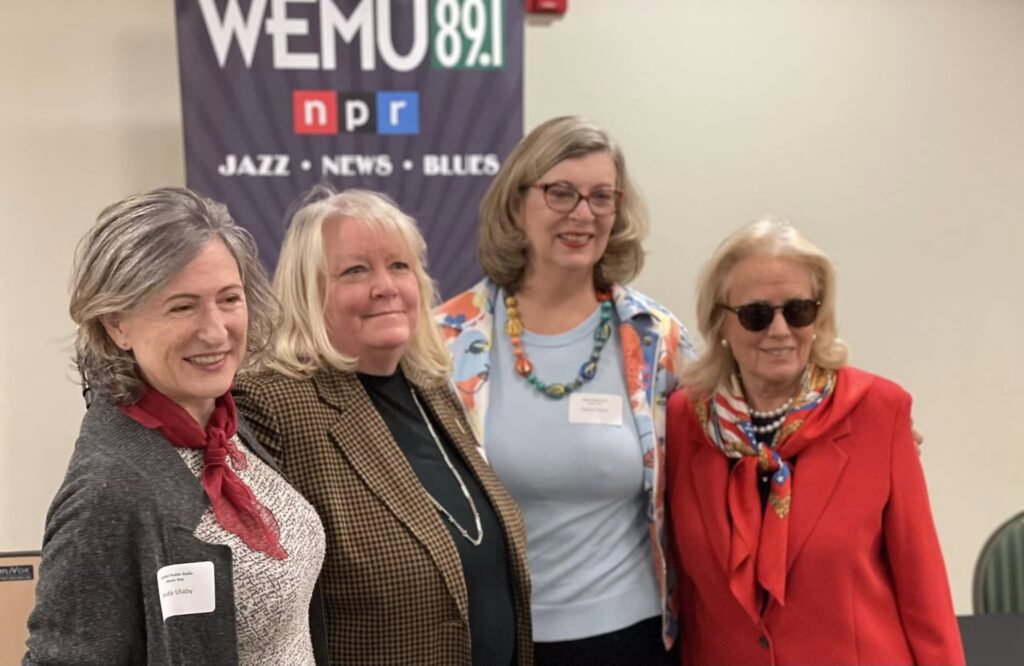
WEMU’s Public Radio Music Day 2024 panel, (from left to right) with moderator Neda Ulaby, WEMU Executive Director and General Manager Molly Motherwell, former President and CEO of Creative Washtenaw Deb Polich, and US Congresswoman Debbie Dingell (D-MI).
In subsequent years, Motherwell tried a luncheon and panel discussion instead. Offered as a donor premium, it drew an engaged audience of station fans. This year, Motherwell made the event invitation-only and reached out to area music educators.
“I try to come at it from a different angle every year,” she says. “One year I did more media stuff, and this year it’s more performers and presenters.”
The point is to show how the pieces connect. The Summer Festival runs three weeks each June, with free music and movies six nights of the week The festival relies on local acts with real followings to bring people out. Motherwell often hears festival-goers say they never knew what was out there. Some listeners go further than that.
“We have this teeny, tiny little woman who is probably in her 60s, like me, who’s learning the marimbas,” she says. “I mean, it’s just, ‘What on earth made you think of that?’ ‘Oh, because I heard X, Y, Z musician talking about it, and it sounded cool.'”
“None of this happens by accident,” says Motherwell. “It’s always people and organizations working together toward a common goal, and I’m an absolute believer in a rising tide lifts all boats.”
Panelist Ellen Rowe, a professor emerita of jazz and contemporary improvisation at the University of Michigan, has watched that tide from three sides. As a musician, she has counted on WEMU to interview her and play her new albums ahead of release shows and local gigs. As a teacher, she points students to the station. “It has been so great to be able to refer students to the station for listening sessions and travel music while driving,” she says.
“It is one big community and WEMU is an integral part of it!” says Rowe.
Prouty, who directs orchestra and choirs at University of Detroit Jesuit High School, has a stock answer for his students. “Students often asked me, what should I be listening to? My response is, tune into WEMU; they play the real stuff,” he says.
For him, the station is one part of a Detroit tradition that runs on older players looking out for younger ones. “This mentorship component is almost as important as the music itself,” says Prouty.
For Lawrence, a lifelong Ypsilanti resident who runs the free John E. Lawrence Summer Jazz Series at Ford Lake Park, what sets WEMU apart is who’s at the microphone. “It’s good to hear real DJs, not just programmed music,” he says.
Motherwell has changed how those DJs make their case during pledge drives. For years, the pitch was a question: Where else are you going to get this music? “And for a long time it was nowhere else, but now you can get it anywhere,” she says.
“I’ve had them change it to, you can get this music anywhere, you choose to get it here. Why? And it’s context and relevance and immediacy.”
Every WEMU music host builds each and every one of their shows. “You can’t playlist that out of some office three states away,” she says.
Those hosts now work out of a new building. Early this year, WEMU left King Hall, a women’s dormitory built in 1934 as a WPA project, for the ground floor of EMU’s Halle Library. Moving 175,000 pieces of music took longer than planned.
“Now everything is new, everything is the same age, everything talks to each other, everything matches,” says Motherwell. “We’re not used to that.”
She fought to have the space named for her predecessor, Art Timko, who started at the station as a student, stayed 42 years and decided WEMU would be a jazz station. In February, EMU’s regents approved the name The Timko Broadcast Center at Halle Library.
“A lot of our team told me, ‘I feel more connected to this place now because of Art’s name being on it,'” says Motherwell. She has just one complaint. “We don’t have any windows.”
The voices at WEMU have changed too. Jewett and David Fair, the station’s longtime news director and local Morning Edition host, both retired at the end of June. Motherwell spent their last three months on the air making sure neither faded away quietly, and turned WEMU’s annual donor party at the Summer Festival into what she called the Jewett Fairwell. Jewett is already back with a Sunday evening show because, she says, he couldn’t stay away. A new local Morning Edition host, Patrick Dunn, went on the air this fall.
“We’re still who we are, and we’ve got these new people in place to take us to even greater places,” says Motherwell.
All of this came in the year after Congress clawed back federal funding for public media. Although WEMU never ran an emergency fundraiser, listeners gave $100,000 to the station anyway.
She hears the same resilience in the music. “Whenever something happens that has the potential to knock them down, the music just evolves,” Motherwell says of jazz. “And I look at public media the same way. We took what was supposed to be a death blow last year, and what happened? The passion for what we do, both on our side and the audience’s side, I think, has actually made us stronger.”
Motherwell calls on other stations to try something like WEMU’s luncheon. “I hope other stations decide to do something more interactive like we do,” she says. “I think it’s just really rewarding.”
Her team has heard her two favorite words, context and relevance, more times than they can count. “My team will tell you those are their two least favorite words because they’re in everything I talk about,” says Motherwell. “That’s how we survive as a small station. We’re you and you’re us.”