
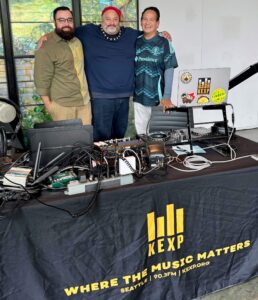
(From right to left) Washington State Representative Chris Stearns with KEXP hosts Kevin Sur and Tory J.
Washington’s House Speaker Pro Tem wants the state to fund public media after the loss of federal support. His reasons start with a car radio in New Jersey.
Washington State Representative Chris Stearns can’t say exactly how old he was when he first connected with music. Maybe it was in his adoptive mother’s car, back when she still listened to the radio. What he remembers are the songs.
“As I got older, five, six, seven, I just turned to music,” says Rep. Stearns. “The radio was my companion because this place wasn’t always great.”
Stearns was born in Los Angeles to a teenage Navajo mother. She’d been moved from a small village in New Mexico under a program that was part of the Indian Relocation Act of 1956. Stearns was placed in foster care the day he was born and spent his first three years in the Los Angeles County system. Then came what he calls “a separate but kind of very similar federal assimilation program” – the Indian Adoption Project – which placed him with a white family in New Jersey.
“I was definitely a fish out of water,” he says. Early on, he felt he didn’t belong, and that he had “just a lack of connection.”
His adoptive parents were extremely religious, and in their house, rock and roll was not allowed. For a kid already on the outside, that only made the radio more appealing. “It made me feel like there was someone out there who understood me,” he says.
Stearns has since moved to Washington and found a way to connect with others in a meaningful way. He now represents Washington’s 47th Legislative District, which covers Auburn, Kent and Covington, and serves as Speaker Pro Tempore of the state House of Representatives.
In January, he and Rep. Liz Berry introduced House Bill 2579, which would have placed a 20-cent monthly charge on phone lines to fund local public broadcasters after the loss of the Corporation for Public Broadcasting. The press release announcing the bill carried a sense of real emotion that rarely appears in legislative announcements: “My mental, emotional, and spiritual health depends on the music and artists that stations like KEXP broadcast.”
“That’s kind of how I testified on my bill,” says Stearns. “I know some of the people on the committee and at least one of them, we share music. And so I did want it to be emotional.”
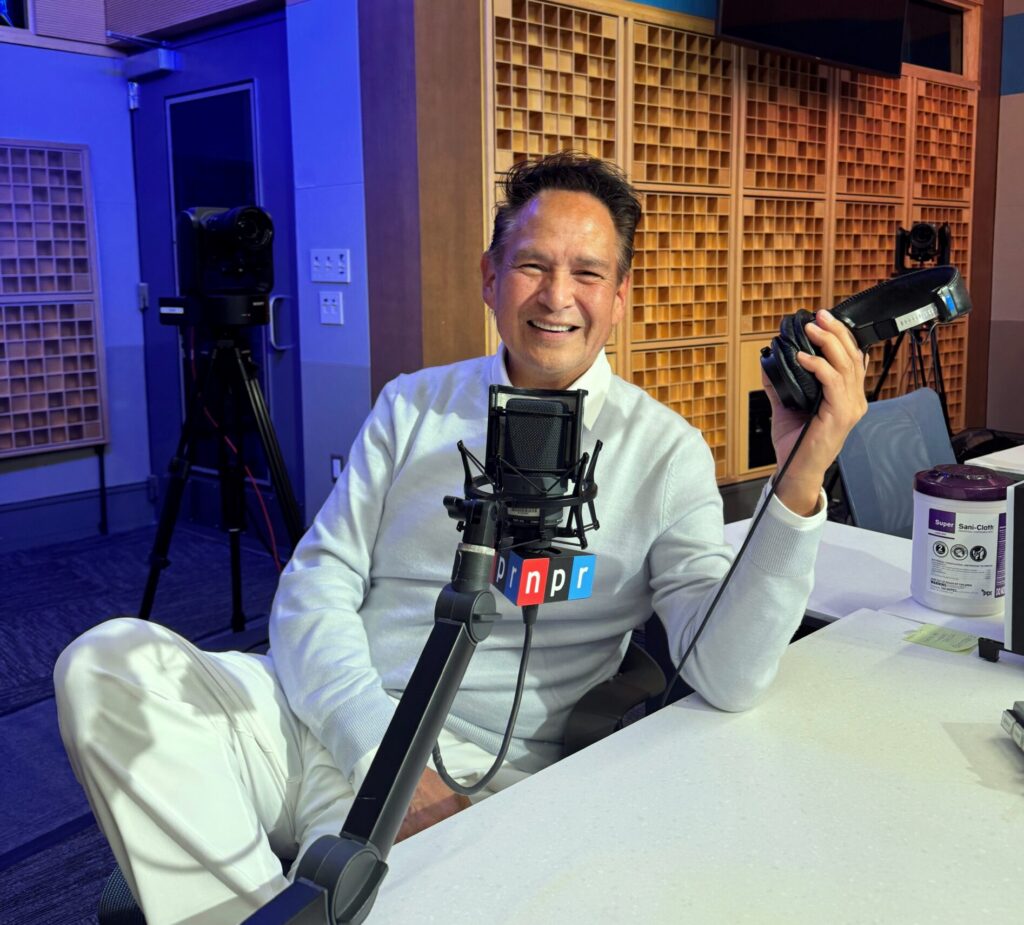
Washington State Rep. Chris Stearns sits at a mic in an NPR studio.
At the bill’s Jan. 30 hearing before the House Technology, Economic Development & Veterans Committee, he set his written remarks aside. “In my own personal experience, music has saved my life,” he told the committee. “I have a t-shirt that says that, and I really wanted to wear that today.”
The feeling hasn’t changed much since that car radio. “That’s still quite magical to this day, that there is a writer, maybe in a different state, maybe in a different country, maybe 50 years ago or maybe five months ago, who puts into words and into song a feeling,” he says. “We’ll probably never meet, but it’s still an incredible connection.”
The bill itself came from a more practical urgency. After Congress rescinded federal funding for public broadcasting in 2025, Stearns heard the news where many listeners did. “When you listen to KUOW or KEXP, they say, ‘Hey, we’re in trouble, because money that we used to have is now gone,’” he says.
He saw it as the same work the Washington Legislature has taken on in energy, housing and health care. “We have to backfill the gap,” he says. “This is our job.” He began, he told the committee, by reaching out to “my favorite local radio station, KEXP.”
Stations testified alongside him. KNKX President and General Manager David Fischer, who also spoke on behalf of Yakima’s KDNA, pointed to the December floods, when KNKX “provided more than 20 emergency alerts and on-the-ground reporting.”
His pitch came down to cost. “For the price of about half a latte a year per line, we ask for your support to pass this bill on to the governor,” he said.
Kevin Sur, co-host of KEXP’s Sounds of Survivance, spoke about the show’s listeners. “Being Native can feel isolating, and I often compare our reality to feeling like an endangered species,” he said. “I can say that this show, which represents thousands of unique public media shows like it, saves lives and offers healing to those who want nothing more for their people.”
What Stearns heard from them went past the budget. “What we need is the voice of artists who can actually help us or maybe connect us, if it’s social media or AI coming down the pipe,” he says. “It’s more urgent that people hear other people’s art, other people’s creation, which brings us together.”
The bill never received a committee vote. The 2026 session was a short one, focused on budget adjustments, and Stearns says a millionaires tax “drained a lot of what oxygen was left.” While Washington state does not fund public media, neighboring states like Oregon and Idaho do. It’s a project Stearns is not ready to give up on. “I absolutely will bring this back,” he says about the bill.
The theme for this year’s Public Radio Music Day is “Sounds Like Home.” For Stearns, home was never a house. “Home is our land,” he says. “I’m Navajo, so we have four mountains that sort of bound our territory, Dinétah. And so home is being centered spiritually in balance, in harmony, and music. God, it totally centers you.”
He reaches for an example plenty of listeners will recognize. “It’s like the last two minutes of Radiohead’s ‘Let Down;’ that is proof that there is a God,” he says. “Home is this land, this spirit that fills the land and the sky and the stars, but it’s a feeling, it’s a presence.”
Public radio also keeps widening that world for him. He listens to Sounds of Survivance and has gotten to know its newest co-host, Dirk Whitebreast, who runs Daybreak Star Radio, an Indigenous-led station out of Seattle’s United Indians of All Tribes Foundation. “I think the last time I ran into him was either at a powwow or it was at the Interpol concert in Tacoma,” says Stearns.
“When I ran into Dirk at the powwow, he had these CDs with marker written on them,” he says. “They were old powwow recordings, and it probably had never been played on a national market. And he was just so excited to be able to share something new to just about everyone.”
“When you hear something new, now your entire spiritual world is growing,” Stearns says. “We’re creative beings at heart.”
The radio once told a lonely kid that someone out there understood him. Stearns hears that message in more places now.
“Music wasn’t first created by humans. Animals created music. The wind sings to us,” he says. “We believe that the earth is living and breathing, so if someone else cares about us, they sing to us. There’s this big universality to it, that it’s not just humans talking to humans, it’s animals talking to us. It’s the trees talking to us.”